In the modern manufacturing landscape, the ability to scale production rapidly while maintaining efficiency is a competitive necessity. As factories move toward full automation, the "end-of-line" process often becomes the ultimate test of scalability. High level infeed palletizers have emerged as the premier solution for businesses that need to handle increasing volumes without a linear increase in floor space or labor costs.
By leveraging vertical space and high-speed mechanical precision, these systems provide a future-proof foundation for growing industrial operations.
1. The Architecture of Scalability
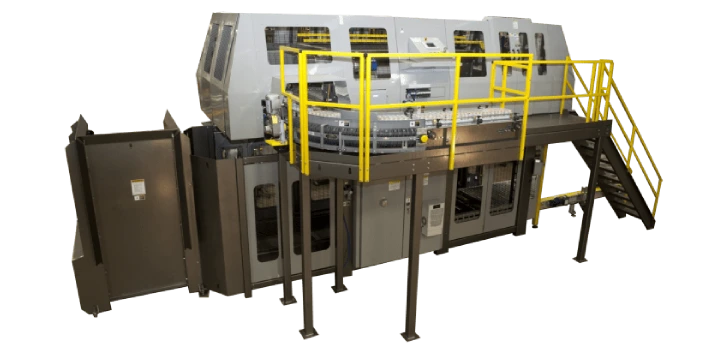
A high level palletizer is fundamentally designed for growth. Unlike floor-level systems that can become congested as more conveyor lines are added, high-level systems utilize the unused vertical cubic footage of a factory. By receiving products at an elevated infeed—typically 2.8 to 3.7 meters high—these machines allow for complex overhead conveyor networks. This architecture means you can add upstream production capacity and simply "plug into" the existing palletizing hub, making it a truly scalable asset.
2. Unlocking Industry-Leading Throughput
Scalability is meaningless if the machine cannot keep up with peak demand. High level infeed palletizers are the fastest category of conventional palletizers. Because they form layers at the top of the machine and lower the pallet as it fills, the "travel time" for the hoist is minimized. This allows for continuous motion and speeds that can exceed 150 cases per minute. For a scaling business, this means the palletizer you buy today for 40 units per minute can often be tuned or upgraded to handle double that capacity as your market share grows.
3. Modular Integration: The Columbia Machine India Advantage
When considering long-term scalability, the choice of partner is as important as the technology. Columbia Machine India Palletizers are built on a modular philosophy. Their high-level systems are not "one-size-fits-all" boxes; they are configurable units that can be adapted with accessories like automatic slip-sheet dispensers, pallet dispensers, and integrated stretch wrappers. This modularity allows a factory to start with a basic automated cell and "scale up" to a fully touchless, high-speed packaging center as their budget and production requirements evolve.
4. Advanced Pattern Management for Product Diversity
True scalability also refers to the ability to handle a growing variety of Stock Keeping Units (SKUs). As a business grows, it often introduces new packaging sizes, weights, or shapes. Columbia’s advanced "Product Manager" HMI (Human Machine Interface) allows operators to create and store hundreds of different pallet patterns without needing a specialized programmer. This flexibility ensures that your automation remains relevant even if your product line changes completely three years down the road.
5. Maximizing ROI Through Reduced Labor Dependency
As a factory scales, the cost of manual labor typically grows exponentially due to management overhead, training, and safety risks. High-level automation flattens this cost curve. A single operator can often oversee multiple high-level palletizing cells. By replacing repetitive, high-impact manual lifting with a high level palletizer, businesses can scale their output by 300% or more while keeping their headcount stable, drastically improving the long-term Return on Investment.
6. Safety and Compliance at Scale
Large-scale operations face stricter safety audits and higher liability risks. Scalable automation must prioritize the protection of the workforce. Leading manufacturers like Columbia include Category 3 safety packages as standard. These include interlocked guarding and light curtains that allow for high-speed operation while ensuring that any human intervention immediately triggers a safe stop. As you scale, having a safety system that grows with your complexity is vital for maintaining a productive and injury-free workplace.
7. Future-Proofing with Data and Connectivity
The final piece of the scalability puzzle is data. Modern high-level systems are ready for the "Smart Factory" era. They can be integrated with Warehouse Management Systems (WMS) and ERP platforms to provide real-time data on production rates and machine health. This connectivity allows for predictive maintenance, ensuring that as you scale your production to 24/7 cycles, your machine has the diagnostic "intelligence" to signal for a tune-up before an actual breakdown occurs.
Conclusion
A high level infeed palletizer is more than just a machine; it is a strategic investment in your factory's future. By providing the highest possible throughput, modular flexibility, and overhead space efficiency, it allows your business to scale without the traditional bottlenecks of manual palletizing. With a partner like Columbia Machine India, you can build an automated end-of-line system that is ready for the demands of today and the unknown challenges of tomorrow.

No comments:
Post a Comment